As we move into summer in the Northern Hemisphere, that means time for scientific conferences! For our purposes at The Incretin Space, that means lots and lots of data, new trial results and importantly, things to write about! The European Congress on Obesity 2026 is ongoing and data was just presented and published on two extremely important clinical trials, both for patients and for clinicians who prescribe GLP-1 meds.
Today let’s look at Surmount Maintain and Attain Maintain.
Both of these trials are looking to prove a point, what maintenance dosing looks like after losing weight on a GLP-1 medication. From a clinical standpoint this is a question I get asked frequently by patients.
I’ve lost weight, now what?
Can we reduce dose? Change medications? What about just stopping the drug but focusing on diet and exercise. That is what both of these trials have provided us today with a topline press release from Eli Lilly noting the following
In ATTAIN-MAINTAIN, participants who transitioned from a maximum tolerated dose (MTD) of Wegovy (semaglutide) to Foundayo maintained all but 0.9 kg of their previously achieved weight loss on average after one year. In ATTAIN-MAINTAIN and SURMOUNT-MAINTAIN, participants who switched from Zepbound MTD to Foundayo or reduced the dose of Zepbound to 5 mg, respectively, maintained all but 5.0 kg and 5.6 kg of their previous weight loss on average after one year
Participants in SURMOUNT-MAINTAIN who remained on Zepbound MTD for an additional year maintained all of their prior weight loss on average
Ok, great so on it’s face maintenance dosing more or less works with a slight amount of weight regain, but there’s SO much more happening under the hood to discuss here. To orient ourselves let’s check out the trial designs first, then we’ll discuss detailed results. Both trials were remarkably similar in how the maintenance phase was designed which helps for comparison sake.
Surmount-Maintain trial:
Period 1 (Lead-in Weight Loss): An initial 60-week open-label period. All participants receive tirzepatide, escalating to their maximum tolerated dose (MTD) of either 10 mg or 15 mg once weekly.
Period 2 (Maintenance): Participants who achieve a weight plateau (defined as <5% change in body weight between weeks 48 and 60) are randomized 1:1:1 into three groups for an additional 52 weeks:
1. Tirzepatide MTD (10 mg or 15 mg).
2. Tirzepatide 5 mg (dose reduction).
3. Placebo (discontinuation).
Participants received rescue tirzepatide if they experienced 50% or more weight regain while on placebo or 5mg or MTD starting at 24 weeks post-randomization.
Attain-Maintain trial:
Period 1 (Lead-in Weight Loss): An initial 72-week open-label period. All participants receive either semaglutide or tirzepatide, with a goal of maximum tolerated dose of tirzepatide (10 mg or 15 mg) or the maximum tolerated dose of semaglutide (1.7 mg or 2.4 mg) subcutaneously once weekly for 72 weeks
Period 2 (Maintenance): Participants who achieve >5% weight loss on Surmount 5 are randomized 3:2 for an additional 52 weeks.
Randomization was stratified by achievement of plateau at week 72 in SURMOUNT-5, sex and percent weight loss at week 72 of SURMOUNT-5 (<20%, ≥20%). Plateau was defined as a weight change of less than 5% between weeks 60 and 72 in the SURMOUNT-5 study.
1. Orforglipron MTD (24 or 36mg).
2. Placebo (discontinuation).
Participants received rescue orforglipron if they experienced 50% or more weight regain while on placebo starting at 24 weeks post-randomization.
In summary the major differences between the trials were:
Surmount Maintain had a 60 week open label lead time vs Attain Maintain which gave participants 72 weeks of lead time.
Surmount Maintain used only tirzepatide while Attain Maintain was an extension of the Surmount 5 trial where patients were either on tirzepatide or semaglutide.
Surmount Maintain patients were then re-randomized to placebo, 5mg or max tolerated dose(MTD) of tirzepatide (3 arms), while Attain Maintain switched patients to MTD or 36mg orforglipron or placebo (2 arms)
Now let’s get into the nitty gritty details here starting with Surmount-Maintain. From a raw percentage standpoint, the MTD Tirzepatide group lost 22.4% of their body weight and essentially maintained that level of weight loss the entire time, with some caveats we’ll explore shortly.
The patients who switched to 5mg Tirzepatide lost 17%, and the placebo group lost 10.1%. These weight loss figures include patients who had to start ‘rescue’ tirzepatide after regaining >50% of the prior weight loss. Broken down by groups, 8% of the MTD group needed rescue dosing, compared to 25% of the 5mg and 67%(!!!) of the placebo.
Let’s see that in a graph form that’s a little easier to understand.

Dotted lines show imputation of weight regain presuming rescue medications were NOT used
Moreover, if we look at this next graph, we can see that the MTD group as a whole, about 72% were able to maintain 85% of their weight lost by continuing on with MTD. With 5mg dose this drops to 33% and only 6.4% of the placebo group was able to maintain their weight loss, but even this doesn’t show the whole story, so let’s turn to more graphs!

These 2 graphs in particular I think highlights best what exactly is happening for this maintenance phase.

Solid lines: No Rescue dosing Dotted lines: Rescue tirzepatide
The MTD tirzepatide we see a nearly equal split of folks either gaining or losing weight. We can see on the left side the folks needing rescue therapy (presumably these folks were on 10mg of tirzepatide and then rescued up to 15mg) tended to be regaining a significant fraction of weight despite the MTD dosing. Conversely there were plenty of people still losing weight in maintenance.
But then look at the 5mg graph and the placebo graph. The vast majority are regaining more than 5% of their lost body weight and most are requiring rescue dosing with only 15% losing or maintaining. The placebo group is in even worse shape. Nearly every single person required rescue tirzepatide, and somehow 2.4% managed to keep losing.
This 2nd graph gives another view of this where a pattern should be immediately apparent.

Do you see the pattern in the MTD and 5mg groups? It’s almost all the slow responders/patients who didn’t lose much weight to begin with that need rescue therapy. Remember for both trials rescue therapy starts if a patient regains 50% or more of their initial weight loss. If you’ve only lost 5kg, then regaining 2.5kg triggers the rescue dosing. But if you’ve lost 20kg, then regaining 10kg while still staying on tirzepatide is a higher bar to clear and outside of 3 outliers that’s broadly what we see. The pattern even holds for the placebo group. Those who lost the most, were least likely to need rescue therapy. That doesn’t mean they weren’t regaining weight. They were as the first graph shows! But they didn’t hit the 50% mark, so no rescue given.
Finally I want to talk about one specific graph for cardiometabolic markers in this trial that really highlights the benefits of these drugs, not just for weight but other indicators of health. This graph looks at blood pressure changes.

As we can see, going off the drug means you lose the blood pressure benefit in a matter of just 6 months. But even reducing the dose to 5mg, reduces the effect. This holds true for multiple other blood markers, going off tirzepatide increases lipids, glucose rises and more. Truly, the majority of the metabolic benefits are just plain lost.
But what happens to weight and metabolic markers if we switch to an oral once daily pill instead?
First a heads up on dosing, because the approved version of orforglipron(Foundayo) is different than what was used in the trial, but they dose equivalent according to the FDA and Eli Lilly.
“This work reports data on the investigational orforglipron capsule formulation of 1, 3, 6, 12, 24 and 36 mg; the doses have been shown as the equivalent to tablet doses of 0.8, 2.5, 5.5, 9, 14.5 and 17.2 mg, respectively, which are approved in the USA”
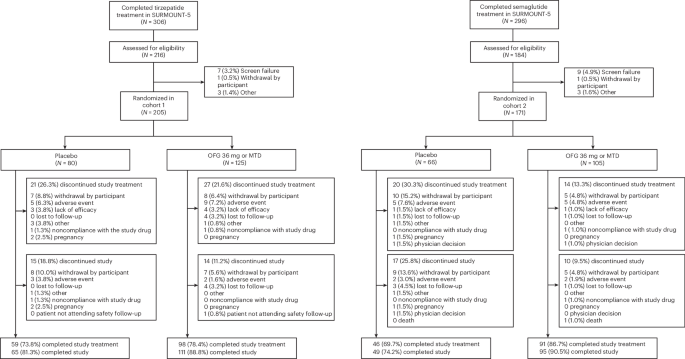
As with Surmount Maintain there was a long open label lead in, this time up to 72 weeks with patients either on semaglutide or tirzepatide, then a 2 week screening period then they were all started on 12mg of orforglipron and escalated to 24mg or 36mg and followed for a year.
The tirzepatide cohort started with 22% weight loss and after 52 weeks of orforglipron had 16.8% weight loss, so on average 5% weight regain. Once again let’s turn to graphs.

You can see these folks were still regaining weight at 52 weeks which isn’t the best news for them! Overall 48% of patients were able to maintain >80% of the weight they had lost when switching from tirzepatide to orforglipron.

Unfortunately this trial doesn’t include a detailed waterfall plot like Surmount Maintain, however some other interesting nuggets emerge, patient in the tirzepatide cohort who reached a weight plateau before being switched to orforglipron, 75% of these patients maintained any amount of body weight reduction compared with 49% with placebo. This suggests 2 things in my mind, one is that reaching a plateau may allow the body to adjust its weight setpoint downwards, even when switching to a lower efficacy agent and two, it seems to slightly increase your odds of keeping some of the weight off if you stopped medications entirely, especially when compared to Surmount Maintain where most patients were NOT at a plateau yet. Without waterfall plots it’s hard to suss this out entirely. Hopefully Lilly will provide these at some point or at a later presentation of the data.
The data does show that only 31% of the tirzepatide group and 18% of the semaglutide placebo groups were able to keep weight regain to <50%. The rest required rescue orforglipron.
What about the semaglutide cohort? This was much more encouraging for Lilly and not what you want to see if you’re Novo Nordisk. After switching to orforglipron for a year there was almost no weight regain, only about a kilogram. That is within the usual weight fluctuations we expect to see over the course of a year for someone not on any weight loss medications which is awesome!

Compared to the tirzepatide cohort about 58% of these patients were able to maintain >80% of their weight loss. 79% of patients at a weight loss plateau prior to switching were able to maintain some amount of weight reduction compared to 37.6% with placebo.
If you want the TL;DR graphic it’s here:

Tirzepatide group gain 10lbs, semaglutide group gain 2 lbs
What about those cardiometabolic markers? This part was perhaps the most encouraging, regardless of which med you start with, cardiometabolic markers were preserved.


The tirzepatide group had slightly worsening of a few markers, and the semaglutide group had some improvement in markers but none of them appear to be statistically significant except for fasting insulin levels in the Semaglutide to Orforglipron group. Why? I’m not sure. Confounded samples are my best bet, but could also relate to orforglipron causing no beta arrestin activity, perhaps giving a ‘cleaner’ receptor signal. Ask again later.
What about side effects? I didn’t mention it for the Surmount Maintain…because they weren’t really worth talking about. Reducing the dose of tirzepatide caused less side effects. Shocker of the year I know.
But what about switching to orforglipron after a 2 week break in dosing? Honestly, pretty good tolerance! Graphs below, but very minimal in the Semaglutide switching group, slightly worse in the tirzepatide group, as they suddenly lose the nausea protective benefits of GIP, but by 6 months the side effects fade for both groups.

What do we take away from this massive amount of data?
From a patient standpoint you have multiple options to be able to maintain your weight loss. Orforglipron or Tirzepatide both work to varying degrees for weight maintenance, a bit of choosing your own adventure, or in the USA, what insurance will cover and what you can afford. From a clinician standpoint the granularity of this data is fantastic, especially in Surmount Maintain.
For clinicians this will basically be my weight maintenance algorithm going forward based on these 2 trials:
Do they have existing cardiac and/or renal risks? If yes, then MTD of either med, especially going from Semaglutide to orforglipron
If no, then did they have at least 15% weight loss or hyper responder weight loss? If yes, then consider 5mg tirzepatide maintenance OR switch to Orforglipron if they want a pill, with close follow up to see if they need to increase back to a MTD of tirzepatide.
If they are a slow responder with less than <10% weight loss, then MTD tirzepatide and don't switch to Orforglipron unless insurance or cost dictates.
All that to say, make up your own mind as a clinician on what you want to do, this is not and never will be medical advice, but rather a suggestion from what the data shows. For patients, you know your body, talk to your doctor and come up with a plan that works for you.
For both groups, just know I’m hitting the highlights with this article and I really suggest taking the time to really read these trials, and digest what they’re saying and I left a lot on the cutting room floor to keep this article easy to read.
My final personal opinions are that both of these trials really put to rest the idea that these are short term medications. They’re not. These results should highlight that most people probably need to be on them for life, or at least as long as possible.
(that sound you hear in the distance is insurance actuaries flipping tables and yelling at me)
Diet and exercise don’t work for weight loss for most people and they don’t work even after significant weight loss. Sorry if that sounds cynical, but our body has an unconsciously defended weight set point and it very much wants to get back to that despite our best conscious efforts. They remain a part of the equation, but ultimately the drugs seem to be doing more of the heavy lifting and we should start educating people to that effect and embrace the benefits they bring outside of just weight loss.
Stay tuned, next article is a preview of the American Diabetic Association Scientific Conference! Retatrutide data is on the horizon!
References: